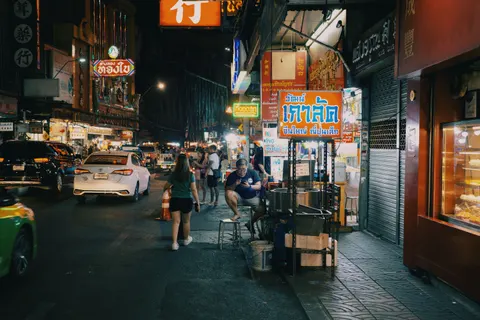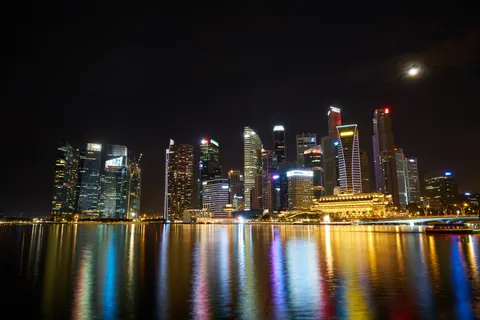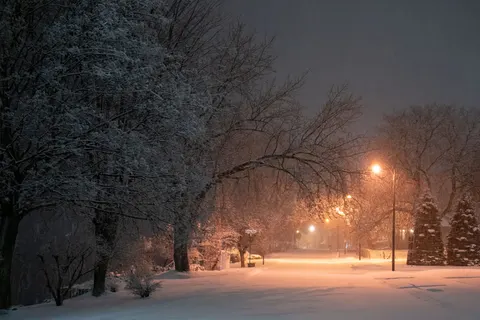
On a windless night well below freezing, a town seen from a little distance can grow a row of vertical beams, one above each lamp, some reaching many times the height of the buildings. Nothing is being projected upward. The air near the ground is carrying flat, six-sided ice crystals, each smaller than a grain of salt, and they fall the way a leaf does, face down and almost level. Each one works as a tiny horizontal mirror.
The light of a lamp travels up, meets the undersides of these plates and is turned back down toward the observer. Crystals at many heights each send a glint, and together the glints stack into a line that sits between the viewer and the lamp, so nobody standing under the lamp itself sees a pillar. The more the plates wobble as they fall, the taller and wider the column becomes. Its colour is simply the colour of the source: orange above sodium lamps, white above LEDs, red or green above a shop sign.
The same reflection happens with the sun when it is close to the horizon, and a single pillar then rises from the glow at dawn or dusk. The town version is rarer and needs the cold to reach all the way down to the street, often colder than minus fifteen degrees. In a photograph it is one of the few night subjects that is naturally tall and narrow, with the dark ground at the bottom and the beams thinning toward the top. On a lock screen that leaves the brightness low in the frame and a plain sky behind the clock.